Answer engines are the new search results — and most brands are invisible in them
Answer Engine Optimization (AEO) — sometimes called GEO, for Generative Engine Optimization — is the practice of getting your brand mentioned, cited, and recommended inside AI-generated answers. When someone asks ChatGPT "what's the best CRM for small agencies?" or types a question into Perplexity, there's no page one to climb. There's one answer, and either you're in it or you're not.
That changes the whole game. Classic SEO tools track rankings, backlinks, and keyword positions. None of that tells you whether GPT-4o name-drops your competitor instead of you, or whether Google's AI Overview pulls its definition from your page or a Reddit thread. A new category of answer engine optimization tools exists precisely to measure and influence that — and they range from pure monitoring dashboards to full content engines.
Below we rank six of the most useful, starting with KAIROS (which we build, so read that entry with healthy skepticism) and then five focused specialists — Profound, Otterly.ai, Peec AI, Scrunch AI, and Goodie AI. We're honest about where each one wins and where it falls short, so you can pick the one that fits your actual problem instead of the one with the loudest homepage.
How we picked these tools
- Real AI-engine coverage — does it actually query ChatGPT, Perplexity, Gemini, and Google AI Overviews, or just scrape one?
- Actionability — does it stop at "here's your visibility score" or tell you what to change and, ideally, do it?
- Honest sourcing — does it show the real citations and source URLs behind an answer, not vanity metrics?
- Pricing transparency — is there a clear entry price a real small business can afford, not just "contact sales"?
- Workflow fit — monitoring is nice, but does it connect to the work of actually publishing content that gets cited?
We weighted hands-on usefulness over feature checklists. A tool that surfaces ten dashboards but never tells you what to publish next ranks below one that closes the loop. Ratings, where shown, come from public G2 review pages; we omit a rating rather than invent one.
Answer engine optimization tools at a glance
| Tool | Best for | Starts at |
|---|---|---|
| KAIROS | Teams who want to measure AND fix AI visibility in one place | From $49/mo (7-day free trial) |
| Profound | Enterprise brands that need deep, defensible AI-visibility analytics | From ~$499/mo |
| Otterly.ai | SMBs wanting affordable AI-search rank tracking | From ~$29/mo |
| Peec AI | Agencies tracking brand mentions across AI models | From ~$120/mo |
| Scrunch AI | Brands auditing how AI crawlers see their site | From ~$300/mo |
| Goodie AI | Marketers who want monitoring plus content recommendations | From ~$149/mo |
See it on your business
Want this run for you?
KAIROS runs the whole marketing loop — content, SEO, ads — from a weekly plan you approve. We love showing founders how it works on their actual business.
We test every new content, SEO/GEO & ads tool the moment it ships.
The 6 best answer engine optimization tools, ranked
1. KAIROS
Our pickFrom $49/mo (7-day free trial)An AI marketing team that tracks your answer-engine visibility and then writes, designs, and publishes to fix it.
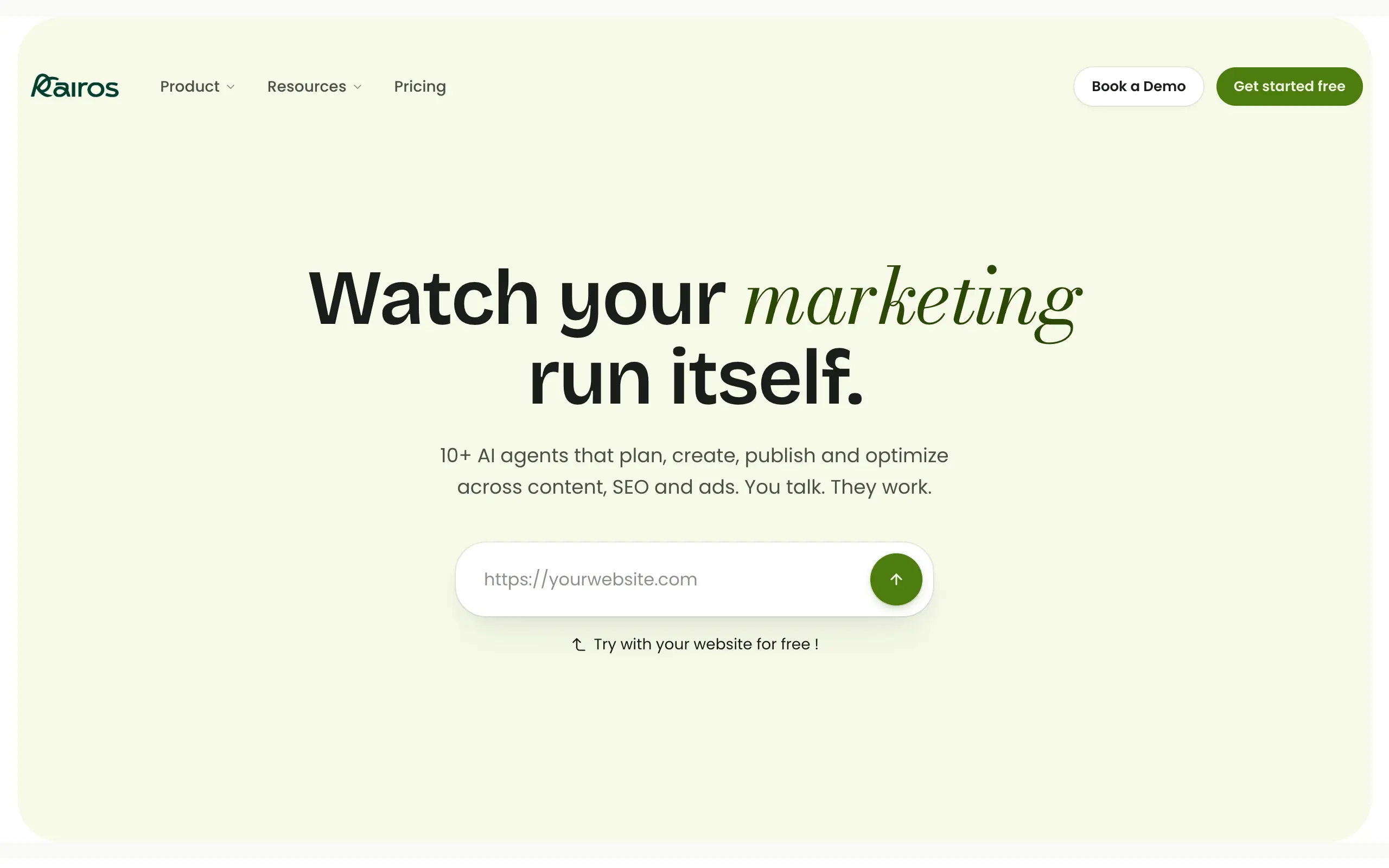
Most answer engine optimization tools are dashboards. They tell you your "AI visibility score" dropped, and then leave you to figure out what to do about it. KAIROS is the opposite bet: it pairs an AEO/GEO monitor (the Compass agent, which queries real grounded engines like ChatGPT and Google AI to see whether they cite you, your competitors, or nobody) with a team of 10+ AI agents that actually produce the content that earns those citations. Scout researches the questions your buyers ask AI, Scribe writes answer-shaped content, Prism designs the visuals, and Beacon publishes — all in one workspace, coordinated by Kairos, the team lead. The premise is simple: visibility you can't act on is just anxiety with a chart.
The honest caveat: KAIROS is newer than the pure-play monitors below, and it's deliberately broad. If your only job is enterprise-grade AI-citation analytics with audit-trail rigor across dozens of models, a specialist like Profound goes deeper on that one axis. And if you genuinely only need a $29 rank tracker, KAIROS is overkill — you're paying for a content-and-publishing engine you won't use. But if you're a lean team tired of stitching together a monitor, a writer, a designer, and a scheduler, the all-in-one math starts at $49/mo with a 7-day trial, and the loop from "we're invisible in ChatGPT" to "we published three answer-shaped pieces about it" happens inside one tool.
Best for: Teams who want to measure AI visibility AND actually move it — without buying five separate tools.
Key features
- Compass agent queries real grounded engines (ChatGPT, Gemini, Google AI) to see if and how your brand is cited
- 10+ specialized AI agents that turn visibility gaps into published, citable content
- GEO/AEO tracking sits next to SEO, social, analytics, and paid ads in one workspace
- Daily blog + structured content engineered to be quotable by answer engines
Strengths
- Closes the loop: measures AI visibility AND produces the content to improve it
- 10+ agents cover SEO, GEO/AEO, social, analytics, and ads in one subscription
- Affordable entry ($49/mo) with a real 7-day free trial
Limitations
- Newer than dedicated AEO monitors, so the analytics layer is less deep than enterprise specialists
- Overkill if all you want is a standalone AI-visibility rank tracker
2. Profound
From ~$499/moEnterprise-grade analytics for how AI answer engines perceive and cite your brand.
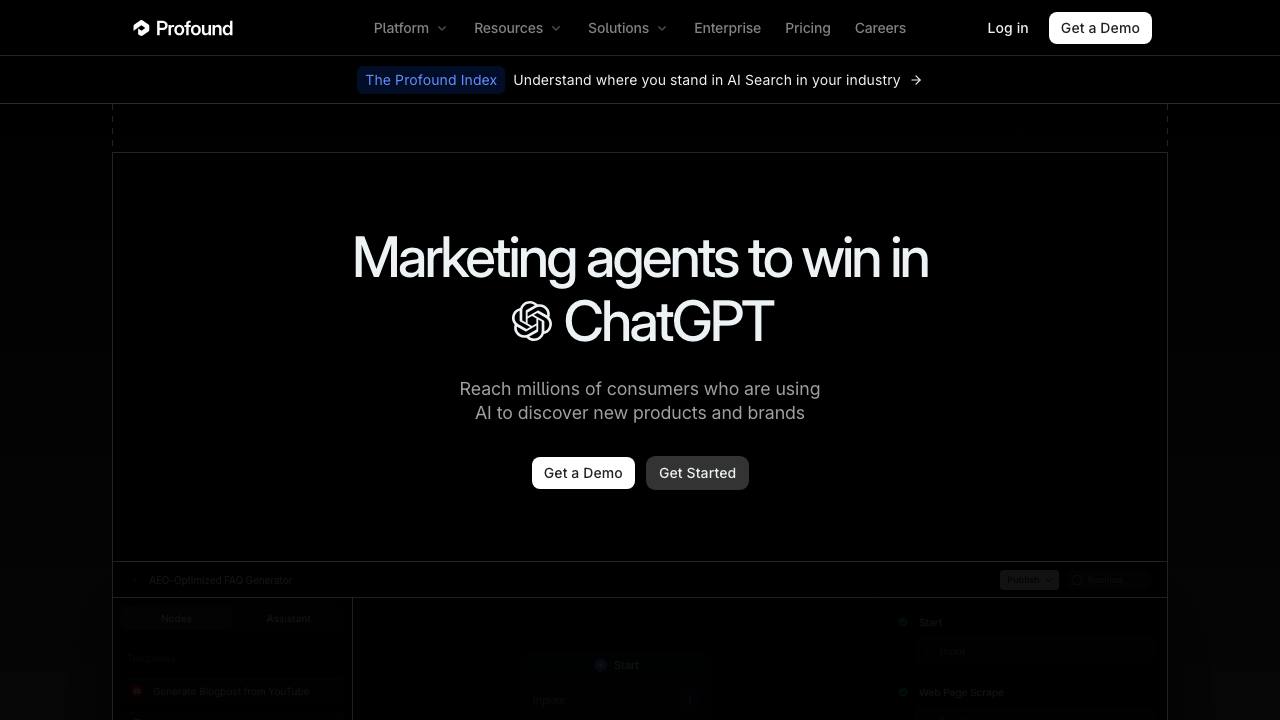
Profound is probably the most respected name in pure AEO analytics, and for good reason. It goes deep: it doesn't just tell you whether you're mentioned, it estimates how much conversation volume your category gets inside AI tools, which sources the models lean on, and how your share of voice trends over time. For an enterprise brand or an agency managing big accounts, this is the kind of board-ready data that justifies a budget line. The agent-analytics piece — watching how AI crawlers actually fetch and interpret your content — is genuinely ahead of most of the market.
The trade-offs are price and scope. Profound starts around $499/mo and climbs from there, which puts it out of reach for most small businesses and solo marketers. And like every tool in this list except KAIROS, it's a measurement layer: it tells you where you stand and what's working, but it doesn't write or publish the content that fixes the gaps. You'll still need writers, designers, and a publishing workflow elsewhere. If you have those resources and need the deepest analytics, Profound is excellent. If you want measurement and execution in one place, you'll feel the seam.
Best for: Larger brands and agencies that need defensible, deep AI-visibility data.
Key features
- Tracks brand presence across ChatGPT, Perplexity, Google AI Overviews, and more
- Conversation-volume estimates: how often people ask AI about your category
- Citation and source analysis showing which pages feed the answers
- Agent analytics to see how AI bots crawl and represent your site
Strengths
- Among the deepest AI-visibility analytics available
- Strong citation, source, and agent-crawler intelligence
- Trusted by enterprise brands and serious agencies
Limitations
- Expensive entry point — out of reach for most SMBs
- Pure analytics; no content creation or publishing to act on the data
3. Otterly.ai
From ~$29/moAffordable AI search rank tracking for ChatGPT, Perplexity, and Google AI.
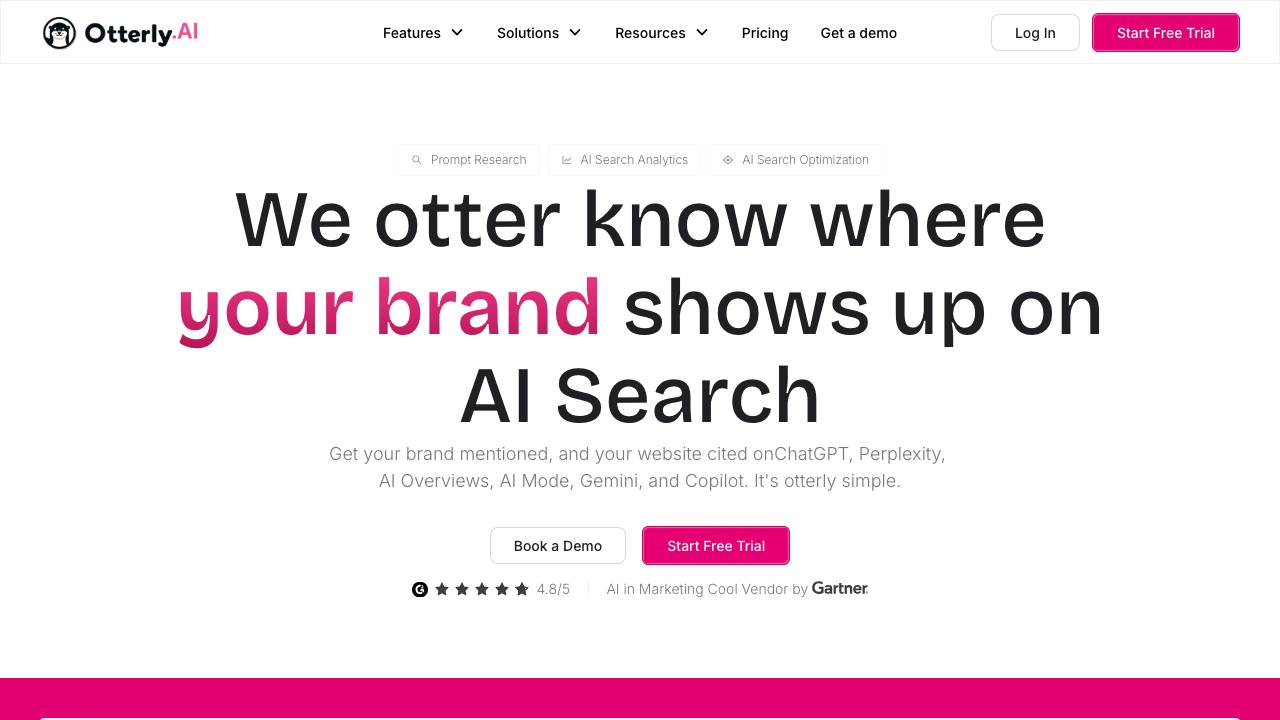
Otterly.ai is the friendly on-ramp to answer engine optimization. Starting around $29/mo, it's one of the few tools in this category a freelancer or small business can buy without flinching. You pick the prompts you care about, and it tells you whether ChatGPT, Perplexity, and Google's AI mention you, link to you, and how they feel about you. The interface is refreshingly un-intimidating — you don't need to be an analytics specialist to get value on day one, which is exactly why a lot of SMBs start here.
The limits are exactly what you'd expect at the price. The data isn't as deep as Profound's, the model coverage is narrower, and like the rest of the monitors here, it stops at insight — it won't write the FAQ page or comparison post that actually earns you the citation. It's a thermometer, not a treatment. For solo operators who just want to know if they're showing up, that's plenty. For a team that wants monitoring and the content machine in one subscription, this is where KAIROS's all-in-one approach pulls ahead despite the higher entry price.
Best for: SMBs and freelancers wanting a low-cost entry into AEO monitoring.
Key features
- Tracks brand mentions and rankings across major AI search engines
- Prompt-level monitoring for the questions that matter to your business
- Sentiment and link-citation tracking inside AI answers
- Simple, approachable dashboard built for non-specialists
Strengths
- Genuinely affordable starting price
- Easy enough for non-specialists to use immediately
- Solid prompt-level mention and sentiment tracking
Limitations
- Shallower data and narrower model coverage than premium tools
- Monitoring only — no content creation to act on findings
4. Peec AI
From ~$120/moAI brand monitoring and analytics built for marketing teams and agencies.
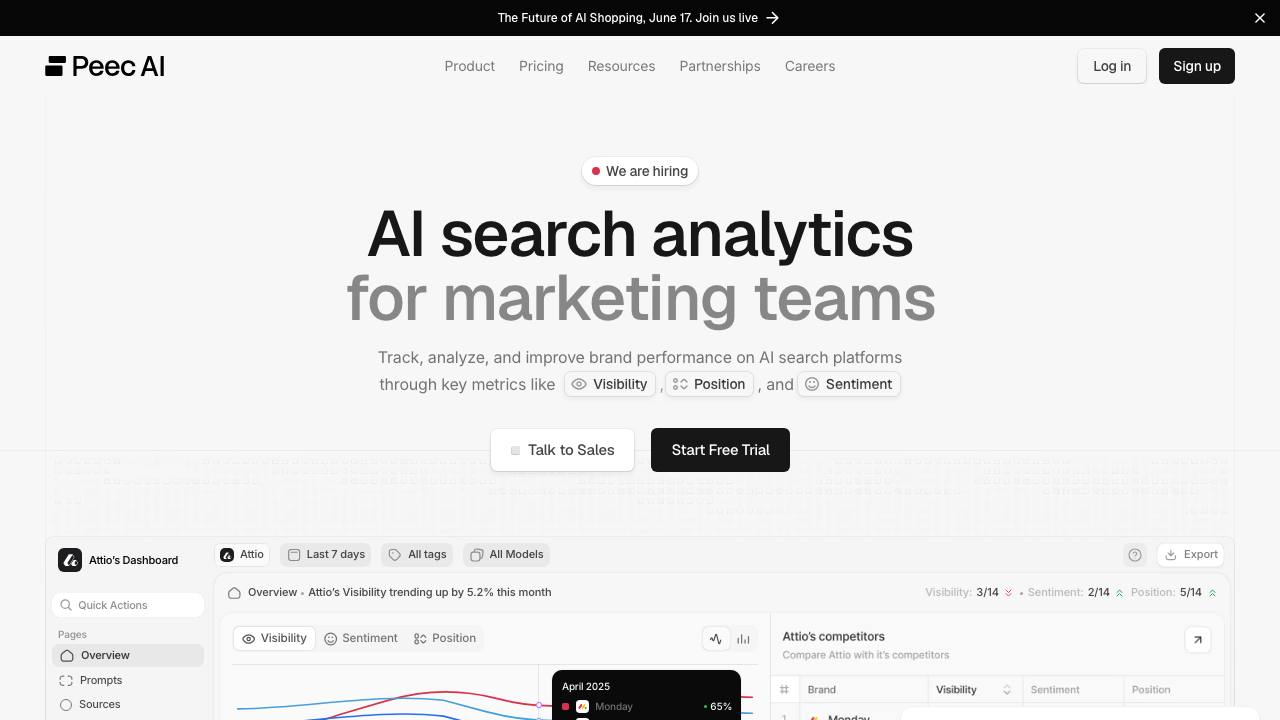
Peec AI has carved out a sweet spot between the bargain trackers and the enterprise platforms. It's built with marketing teams and agencies in mind, so the competitor-benchmarking and share-of-voice views are a real strength — you can see at a glance whether the AI models are recommending you or the three rivals you actually lose deals to. The reporting is clean enough to put in front of a client, and coverage across the major models is solid. At roughly $120/mo to start, it's a reasonable middle tier.
Where it lands as a monitor, not a solution, is the same story as the rest of this tier. Peec tells you your share of voice is slipping and which competitor is eating your citations; it does not produce the content that wins them back. Agencies often pair it with a separate content stack and a scheduler, which means more tools, more seats, more context-switching. KAIROS's pitch against Peec is consolidation: the same competitive AI-visibility signal, plus the 10+ agents that turn that signal into published work — under one roof and one bill.
Best for: Agencies and teams tracking brand share-of-voice across multiple AI models.
Key features
- Tracks brand visibility and competitor share across ChatGPT, Perplexity, Gemini and more
- Competitor benchmarking inside AI answers
- Source and citation analysis to see what content the models trust
- Team- and agency-friendly reporting
Strengths
- Strong competitor benchmarking and share-of-voice views
- Client-ready reporting suited to agencies
- Good coverage across major AI models
Limitations
- Analytics only — still need a separate content and publishing workflow
- Mid-tier pricing adds up once you stack it with other tools
5. Scrunch AI
From ~$300/moAudit and optimize how AI agents and crawlers experience your website.
Scrunch AI comes at the problem from a more technical angle than the others. Its standout idea is treating AI agents and crawlers as first-class visitors: it audits how those bots actually fetch, parse, and represent your site, then flags where your structure, markup, or content is letting you down before an answer engine ever cites you. For brands with a big, complex site and a real concern that the models are misreading them, this crawler-experience lens is a genuinely differentiated and useful perspective.
It's also more of a specialist's tool, and priced like one (from roughly $300/mo). The technical focus that makes it valuable also makes it narrower: it's excellent at diagnosing the infrastructure and structure side of AEO, less so at the ongoing editorial work of producing quotable answers, week after week, across a content calendar. Like the others, it tells you what to fix more than it fixes it. KAIROS overlaps on the 'make our content citable' goal but approaches it through continuous content production rather than one-off technical audits — different tool for a different bottleneck.
Best for: Brands that want to fix the technical, crawler-facing side of AEO.
Key features
- Audits how AI crawlers and agents read and represent your site
- Surfaces gaps in how your content is structured for AI consumption
- Monitors brand presence across answer engines
- Recommendations to make your site more 'AI-readable'
Strengths
- Unique crawler- and agent-experience auditing
- Great for diagnosing technical and structural AEO gaps
- Useful for large, complex sites
Limitations
- Narrow technical focus; thin on ongoing content execution
- Higher price point aimed at bigger organizations
6. Goodie AI
From ~$149/moAI-visibility monitoring paired with content recommendations to improve it.
Goodie AI is interesting because it tries to bridge the gap that almost every other monitor leaves open: it doesn't just track your AI visibility, it recommends content to improve it. That's a meaningful step beyond a pure dashboard — instead of handing you a falling line and a shrug, it points at the topics and gaps you should address to start showing up in answers. For a marketing team that has writers but lacks an AEO strategy, those recommendations can be a useful compass.
The distinction from KAIROS is execution depth. Goodie tells you what to write; KAIROS's 10+ agents actually research, write, design, and publish it, then watch whether the answer engines start citing the result. Goodie's recommendations still hand the real work back to your team, and at around $149/mo it's priced as a guidance-and-monitoring layer rather than a production engine. If you already have a content team and just want smart direction, Goodie is a solid fit. If you want the direction and the hands to do the work, that's the line where an agent-based platform takes over.
Best for: Marketers who want monitoring plus guidance on what to publish next.
Key features
- Monitors brand mentions and sentiment across AI answer engines
- Content recommendations aimed at improving AI visibility
- Competitor and source tracking
- Reporting geared toward marketing teams
Strengths
- Goes beyond monitoring with actual content recommendations
- Useful direction for teams that lack an AEO strategy
- Reasonable mid-tier pricing
Limitations
- Recommends content but doesn't produce or publish it
- Less established than the category's bigger names
How to choose the right answer engine optimization tool
There's no single best tool — there's a best tool for your specific bottleneck. Be honest about which of these is actually you:
If you only need the deepest, most defensible ai-visibility analytics for an enterprise brand…
Pick: Profound
If you just want a cheap, simple way to check if ai engines mention you…
Pick: Otterly.ai
If you run an agency and need competitor share-of-voice across models…
Pick: Peec AI
If you have a big, complex site and suspect ai crawlers are misreading it…
Pick: Scrunch AI
If you want to measure ai visibility and have a team actually write, design, and publish the content that fixes it — without buying five tools…
Pick: KAIROS
The verdict
If your problem is purely measurement, the specialists win on depth: Profound for enterprise analytics, Otterly.ai for affordable simplicity, Peec AI for agency benchmarking, Scrunch AI for technical audits, Goodie AI for monitoring-plus-recommendations. But measurement is only half the job — knowing you're invisible in ChatGPT doesn't make you visible. KAIROS earns the top spot because it closes that loop: the Compass agent shows you exactly where you stand in AI answers, and 10+ specialist agents do the research, writing, design, and publishing to change it, all from $49/mo. It's newer and broader than the pure monitors, and genuine overkill if a $29 rank tracker is all you want. But for a lean team tired of duct-taping a monitor to a writer to a scheduler, owning the whole loop in one place is the unlock.